
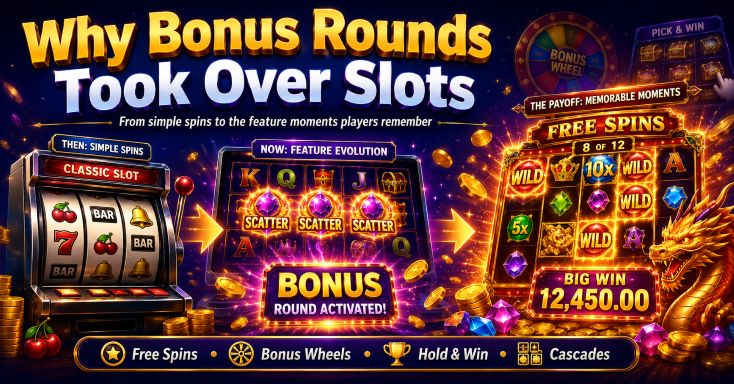
Early slots were, by definition, simple: they had a lever you pulled; three reels spun; and you either matched the symbols, or you didn’t. This was the entirety of the mechanical experience — the simplicity and the physical nature of the clunks of the reels and the clinks of the coins spilling into a tray — and there was nothing else. Video slots arrived in the late 20th century to replace the old mechanical units, but the design philosophy didn’t change until much later. Digital video slots continued to function pretty much as digital versions of the mechanical designs — spin, match, pay.
That’s when things began to change. Most slot historians believe the first significant innovation came from IGT’s Wheel of Fortune machine. This launched in casino floors in the mid-90s and created a new experience by providing a player with a legitimate reason to want to land a combination of symbols other than simply creating a payline. To do this, a wheel would light up above the machine (sometimes massive) and begin spinning. In addition to attracting players who wanted to see if they could create a large win, it provided an element of drama, or “theater” as we call it.
From then on, second screen Bonus events proliferated. Players would enter a Bonus round after landing a designated symbol and be presented with a second screen where they would pick items to earn cash or other awards. While these were technically known as “pick and click” Bonus games, they represented an important development in terms of giving players agency while playing the Bonus round.
Eventually, free Spins took over as the preferred method for delivering bonuses, primarily due to cost considerations. Building a free Spins feature is relatively inexpensive compared to building a more complex Bonus structure such as a pick and click. Additionally, free Spins are generally easier for players to understand at a glance. Finally, they are flexible enough to incorporate virtually any type of modifier. For example, players do not need to be told the rules of a free Spins round. All they need to do is land 3+ scatter symbols and they will receive a fixed number of free Spins with no risk of losing their original wager.
What ultimately elevated free Spins beyond being simply another feature was the creative ways in which developers stacked modifiers on top of the core mechanic. Multipliers enabled what may otherwise have been a low-value win to become substantial. Sticky wilds remained active throughout the remainder of the round, enabling players to collect additional consecutive wins.
By the time online slots evolved into their own distinct genre rather than digital clones of their land-based counterparts, free Spins had established themselves as the benchmark by which players judged a game prior to ever having played it. Online slot Reviews and forums frequently refer to “the Bonus” as shorthand for describing the complete character of a slot.
If a game has an unimpressive free Spins round, it is dismissed regardless of whether its base game mathematics are spotless. Conversely, if a game has an impressive free Spins round, it can sustain a subpar base game for an extended period. This difference in how players assess slots gives insight regarding where the true entertainment value currently lies.
The psychology behind why the occurrence of three scatter symbols lighting up freezes the screen, changes the music and heralds the arrival of the real game is based upon how rarely and how noticeable this event occurs. Bonus Rounds are designed to occur sporadically. Their occurrence varies depending upon the game, but on average they occur anywhere from once every 100 Spins to once per 500 Spins on high volatility games. This rarity is intended. Consistent, predictable rewards rapidly lose their emotional impact. Rewards that occur randomly tend to maintain their emotional allure significantly longer than consistent rewards provide.
Additionally, Bonus Rounds alter the timing and pacing of a game. Regularly occurring base game Spins typically provide rapid feedback that is mostly neutral — e.g., small wins, near misses and occasionally small payouts. However, during a Bonus round, both the pace of the game and the feedback slow considerably. Music transitions to more dramatic pieces; animation becomes more elaborate; and there is an obvious escalation of the risks involved.
In addition to altering timing/pacing, Bonus Rounds also produce a strong near-miss effect. Landing two scatter symbols and watching the third symbol fail to appear in a location that would have activated the feature creates a genuine emotional response despite the fact that this scenario has absolutely no influence on subsequent spin probabilities. Many slot manufacturers deliberately weight their reels to generate this type of experience in order to maximize player engagement.
Finally, Bonus Rounds deliver a disproportionate amount of a slot’s overall return-to-player percentage in comparison to base game Spins. In many modern high-volatility titles, for example, the bulk of the overall RTP is generated by the Bonus round rather than through steady base game returns.
Designing slots with bonuses as the focus
All slots have a return-to-player (RTP) figure and volatility profile, and neither is coincidental. Each developer allocates a feature budget — i.e., determines ahead of time how much of the overall RTP will go towards the base game versus how much will be reserved for the Bonus round(s). On low-volatility slots, this ratio tends to be relatively balanced. The base game provides players with small frequent wins while the Bonus adds slightly greater value.
On high-volatility games built to encourage play of the Bonus round, however, base game performance may intentionally be sparse and choppy; i.e., nearly all win potential will be tied to a feature that triggers rarely but pays extremely well when it does Trigger.
Each developer will optimize against three key variables:
1) frequency of Bonus triggers (e.g., ~every 150 Spins)
2) average duration of Bonus (e.g., 8-15 free Spins)
3) maximum possible win multiplier (e.g., ~2000x staked)
Narrative design has recently begun to factor into this decision-making process as well. Cinematic intro sequences, story arcs that unfold over an entire session, level-up structures and branded tie-ins to movies/tv shows all exist solely to help players perceive their waits between triggers as progress toward something rather than simply waiting for something to happen. Some studios (Play’n GO and Pragmatic Play among others) are leaning hard into themed/Bonus-arc stories where the feature itself has stages or a payoff at the end rather than being a single flat event.
Bonus buy Features represent perhaps the clearest embodiment of this entire shift. Instead of waiting for potentially hundreds/thousands of base game Spins to hopefully trigger a feature organically, players on many online titles can now simply purchase access to the Bonus round using a fixed multiple of their stake (usually ranging from 80x – 200x). The sole existence of this feature represents recognition by operators and developers that for a considerable portion of players, the actual draw was never really the base game — it was only ever the toll booth en route to where they actually wanted to be.
Regulatory attitudes towards Bonus buy have shown significant shifts in several jurisdictions in recent years — including full banning/restrictions in certain markets due to concerns that it removes pacing typically associated with organic Bonus hunting.
Common Bonus round types found today
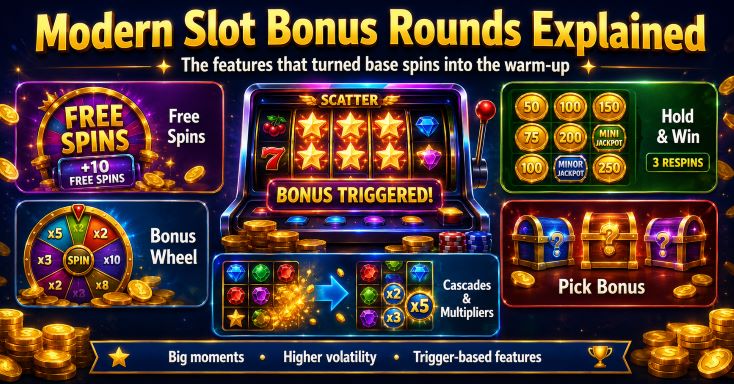
Many different types of Bonus mechanics exist today, but most Bonus Features found in modern slots fall into one or more of the following categories:
Free Spins Rounds featuring increasing multipliers remain the industry standard.
Hold & win Rounds (also referred to as money symbols or respin Features), lock certain symbols and give players a limited number of respins to fill remaining positions.
Pick & click Bonus games still show up frequently — especially among titles targeted at casual audiences.
Cascading/tumbling reels create a chain reaction effect by removing winning symbols and replacing them with new ones falling downward through remaining spaces often combining with an increasing multiplier to extend wins across subsequent Spins.
How do Bonus Rounds change how people behave?
Ultimately, none of this effort would have mattered if it did not fundamentally change how people behave when playing slots — and it has. Players increasingly view the base game as something to get through as quickly as possible rather than enjoying it for its own sake — which represents an important shift in how players consume experiences.
The introduction of Bonus Buy features raises this behavior further still — allowing players to skip straight to the volatility without going through the natural pace that comes with grinding for it which can accelerate losses in ways that may not be perceptible immediately. None of that means that Bonus Rounds are something to avoid -done properly (i.e., with math and visuals), they represent the best part of modern slot design it just means approaching them as you would any other form of high-variance entertainment spending — set limits prior to starting the session rather than afterwards when your heart is racing watching the near-miss on screen try to convince you to spin one more time.
Will Bonus Rounds define the Future of slots?
If trends continue unabated, then complexity will increase — not decrease. Hybrid mechanics that combine dynamic reel counts like Megaways with layered Bonus structures — or cluster-pay grids leading into multi-stage Bonus arcs — show up frequent enough to make simpler versions of slots struggle to get attention even though their math is perfectly sound.
Conversely, regulatory pressure on aggressive monetization tools like Bonus buy is real and growing within certain markets — thus suggesting the industry won’t receive unlimited freedom to escalate volatility and feature pricing forevermore.
A smaller counter-trend has developed quietly in contrast: experienced players gravitate back to simpler/lower-volatility games because they’ve grown fatigued with long sessions where a Bonus has been starving and prefer more steady/predictable gameplay.
What causes a Bonus round?
Typically, it’s landing 3+ scatter symbols anywhere on the reels as opposed to landing them on a particular payline although some games include random/mystery triggers that can activate on any spin regardless of what’s on display.
Does a Bonus round guarantee a win?
No — it greatly increases your chances of winning but ultimately, the results within a Bonus round are still determined by the same random number generator governing every spin.
Can a Bonus round be re-triggered?
Yes, in many cases where the Bonus round is free Spins, landing additional scatter symbols during the round extends it further with more Spins, although exact rules vary between titles, and some games cap the max # retriggers